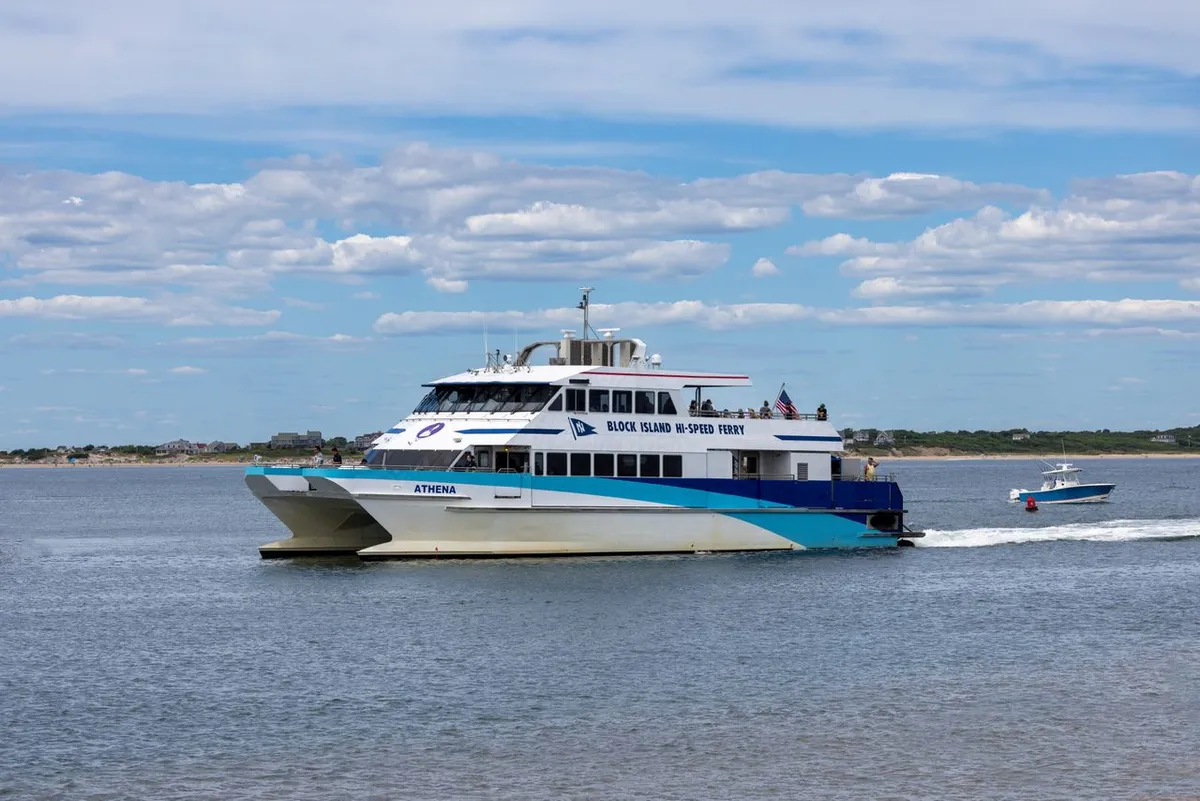
If you are taking the ferry to Block Island, there is a good chance it leaves from Point Judith. This is the busiest of the four mainland ferry ports, the only one that runs year-round, and the only one that can put a car on the island. The terminal sits in the village of Galilee, on the southern tip of Narragansett, Rhode Island. From here, the Block Island Ferry runs two boats — a traditional car ferry and a high-speed catamaran in season — across nine miles of open Atlantic to Old Harbor on Block Island. This guide is the practical version. Where to drive, where to park, when to leave, what to expect on board, what to do once you land. If you have not picked your route yet, our full Block Island ferry guide compares all four mainland ports first.
One thing worth knowing before you sail, because it changes how you plan the first hour: the boat lands you in Old Harbor, and Ballard’s is right there on the sand next to the landing. Walk-ons with no car and a few hours to fill can be sitting down with a drink faster than most people find their rental bike. It is the only stretch of beach on the island with a kitchen, a bar, and a live music stage behind it, which is why day-trippers end up there by default.
The Point Judith Ferry Terminal
The terminal address is 304 Great Island Road, Narragansett, RI 02882, in a stretch of waterfront known as Galilee State Pier. Galilee is a working fishing village, so the road in passes a row of seafood markets and clam shacks before opening up to the harbor and the ferry docks. Once you turn onto Great Island Road, you cannot really get lost. The road dead-ends at the terminal, and the parking lots line both sides as you approach. The actual ferry building is small — a ticket counter, a snack stand, restrooms, and a covered waiting area where the ferry boats pull right up to the bulkhead. Allow extra time if you have never been. Galilee gets congested on summer mornings, and the lots fill up. Arriving 45 minutes before your sailing is the right amount of time in summer; in shoulder season, 20 minutes is plenty.
How to Get to Point Judith
Point Judith is in the southern coastal portion of Rhode Island, about a 30-minute drive from Providence and a 90-minute drive from Boston. Common driving routes:
- From Boston: I-95 South to Route 4 South to Route 1 South. Exit at Scarborough Beach / Galilee.
- From Providence: Route 4 South to Route 1 South. Exit at Scarborough Beach / Galilee.
- From New York City: I-95 North all the way to Route 4 South. About 3 hours without traffic.
- From Connecticut: I-95 North to Route 1 East. From New London, Route 1 stays scenic.
If you do not want to drive at all, Amtrak runs to Kingston, Rhode Island, about 15 minutes from the terminal. Uber and Lyft cover that final leg cleanly. The same train continues to T.F. Green Airport in Providence if you are flying in.
Two Boats from One Dock
The Point Judith terminal runs two completely different boats. They both go to Block Island. They are not the same trip.
The Traditional Ferry
This is the year-round, larger boat. Crossing time is about 55 minutes. It carries cars, motorcycles, bikes, and walk-on passengers. Open top deck, enclosed cabin, snack bar, restrooms. The traditional ferry is the right pick if you are:
- Bringing a car
- Traveling outside the May-to-October window
- Looking for the lower fare
- Bringing a dog or oversized luggage
- Hoping for that out-on-the-water feeling
The fare is around $18 each way for adults, $10 for kids, and $5 for a bicycle. Cars run about $130 each way in season. Walk-on tickets are sold at the window minutes before departure; cars must be reserved well in advance.
The High-Speed Ferry
A passenger-only catamaran, May through October. Crossing time is about 30 minutes — almost half the traditional ferry. Smaller boat, more enclosed, no cars. Pick the high-speed ferry if you are:
- On a day trip and want maximum island time
- Skipping the car (most visitors do)
- Easily seasick (less time on the water means less time to feel it)
- Traveling on a tight schedule
Adult one-way fare runs about $30, kids about $20. Reservations are not strictly required but are smart for summer weekends. A quick note: most first-time visitors overestimate how badly they need a car. Block Island is small, the bike loop is one of New England’s classic rides, and the local taxi service handles the rest. Bringing a car costs more than the ferry ticket itself. We have a whole article on Block Island without a car if you are weighing this.
Schedule
The schedule shifts by season. The summary below covers a typical year — confirm exact times on the operator’s site before you travel.
Summer (Memorial Day to Labor Day):
- Traditional ferry: 6 to 9 round trips per day. First boat out around 8:00 AM, last return from Block Island around 7:30 PM.
- High-speed ferry: 3 to 5 round trips per day. First out around 9:30 AM, last back around 8:00 PM.
Shoulder season (April–May, September–October):
- Traditional ferry: 4 to 5 round trips per day.
- High-speed ferry: limited weekend-only service early or late in the season.
Winter (November to March):
- Traditional ferry only: 2 round trips per day, sometimes more on weekends.
- No high-speed ferry.
If you are doing a day trip, the schedule shapes the entire day. Take the earliest practical boat over and the second-to-last back. The last boat is the riskiest — if anything throws you off (a long wait at lunch, a flat bike tire), you do not want to be sprinting for the dock.
Tickets and Reservations
Walk-on passengers can usually buy tickets at the terminal window 30 minutes before departure. The line moves fast. In peak summer, online ordering saves time. Cars on the traditional ferry are a different story. They sell out weeks in advance for summer weekends, holidays, and whenever there’s a forecast for good weather. If you need a car on the island, book the ferry the moment you book your hotel. Standby for cars: When a sailing is full, a small number of standby spots open at the dock. You arrive an hour and a half early, get in line, and wait. It works more often than people think — but never count on it for the trip out, only for the return.
Point Judith Ferry Parking
Parking at Point Judith is a system, not a lot. Several different operators run lots at different distances from the terminal, with different prices and shuttle arrangements. The full breakdown — which lot is closest, which has shuttles, which costs more — is in our dedicated Block Island ferry parking guide. The short version:
- Closer-in paid lots: $20–$25 per day, walking distance to the terminal.
- Outer lots: $15–$18 per day, with free shuttle service to the terminal.
- Long-term parking: discounted weekly rates if you are staying on the island for more than a few days.
- Reserve in summer: the close-in lots fill up by 9 AM on weekends.
Whichever lot you pick, write down where you parked. After two days at the beach, “row B, somewhere on the right” all looks identical at 6 PM in late summer light.
What to Eat Before the Boat
Galilee is a working fishing port, which means the seafood near the terminal is genuinely good. Two long-running clam shacks within walking distance of the parking lots — one with a longer line, one with the picnic tables out back — are the standard pre-ferry stop. Fried clams, lobster rolls, chowder. Do not order anything more ambitious; this is a fryer-and-roll situation, and they are good at it. The ferry has a snack bar onboard, but if you have a real meal in mind, eat in Galilee before you sail. Once you are on Block Island, the dining options open up — but you will probably not eat for an hour after you land, between hauling bags and getting to your hotel.
On the Boat
The traditional ferry is bigger than first-timers expect. Three decks: a vehicle deck below, a main passenger deck with the snack bar and big windows, and an open top deck with bench seating. The top deck is where almost everybody ends up if the weather is not actively bad. Bring a sweatshirt even in summer. The wind on the open deck cuts through a t-shirt fast, and the temperature drops noticeably once you push out of the harbor. Sunscreen if you plan to sit topside the whole way. The crossing itself is mostly calm. The water between Point Judith and Block Island can roughen up in a strong south wind, but in normal conditions it feels steady. People prone to motion sickness should sit toward the middle of the boat and on the lower deck — not the bow. The high-speed ferry rides differently. Lower, faster, more enclosed. Less wind, less view, less time. Many people prefer it; many people do not. There is no wrong answer.
Arriving at Old Harbor
The Point Judith ferry lands at Old Harbor, the village heart of Block Island. The dock is in the middle of New Shoreham, surrounded by inns, shops, and restaurants you can see from the boat as you pull in. The first 200 yards off the boat are the busiest stretch you will see on the island. Taxis line up curbside. Bike rental shops sit a block away in three directions. The closest hotels — the Surf Hotel, the National Hotel, the Inn at Old Harbor — are all within a five-minute walk of where you step off the boat. If you are staying farther out, like at the 1661 Inn, Spring House, or Atlantic Inn, most properties offer pickup if you call from the dock. Or grab a taxi. For where to head once you are settled, our Visit Block Island page is the overview, and What to do on Block Island collects the activity guides.
Frequently Asked Questions
How early should I arrive at the Point Judith ferry?
In summer, 45 minutes early. In shoulder season, 20 minutes is enough. If you are bringing a car, the operator wants you in line at least 30 minutes before sailing or you can lose your reservation.
Where is the Point Judith ferry to Block Island?
The terminal is at 304 Great Island Road, Narragansett, Rhode Island, in the village of Galilee. About 30 minutes south of Providence by car.
How much is the Point Judith ferry to Block Island?
Adult walk-on fare is around $18 each way on the traditional ferry, $30 each way on the high-speed. Cars are about $130 each way in season. Children, bicycles, and seniors get reduced rates.
Is the Point Judith ferry the same as Block Island Ferry?
Yes. “Block Island Ferry” is the brand name for Interstate Navigation, the company that operates both the traditional and high-speed ferries from Point Judith (and the seasonal Newport route).
Can you walk onto the Point Judith ferry without a reservation?
Yes, walk-on passengers almost always get on. Reservations are required for vehicles, not foot passengers.